



Repurposing and adapting old buildings often results in awkward layouts, ungainly rooms forced into incongruous crannies, refrigerators and toilets sprouting in vestibules.
Unlike Elvis, we are in the building. It took a minute to figure out where to hold the security fob, but the sliding glass doors have yielded, revealing the gilt-accented, marble-clad lobby of Le Tanagra. (Nearly every dwelling here has a name.) Thank Freon, it’s cool in the lobby. Europe is suffering a killer heat wave. (Literally; most of the housing here is not air-conditioned, and people are dying from the heat.) Because our long day’s journée into nuit has drained our resources, the humidity outside the lobby is oppressive.
By my Timex it’s 9:30pm, 21:30 by the 24-hour clock most of the world uses. (Eighteen countries use a 12-hour clock.) France is nine hours ahead of California, so in LA—home—it’s 12:30pm. On the plane, Karen the Navigator got some meclizine-aided sleep, but I’ve been awake for 30 straight hours, 14 of those pummeled by jet roar. We’re both numb, plodding, and longing to get into our apartment. And into bed.
We have triumphed over the first two trials of Airbnb’s self-check-in challenge: We stopped by a small, nearby hotel and picked up the building’s security fob; and we used it to penetrate Le Tanagra’s outer defenses. The third and fourth trials are: get up to the apartment, and get into the apartment. Our instructions, which the Airbnb app has translated from the apartment owner’s Korean, say to take the elevator to the 7th floor, go to the first door on the right—apartment doors here often don’t have identifying numbers or letters—then punch in a six-digit code. Easy-peasy.
Except there’s no elevator. Wait, what? Not possible. We’re on the French Riviera in the lobby of an 8-story—ground floors here are considered 0, not 1—luxury apartment building comprised of multi-million-euro, large-terraced, Mediterranean-facing condos owned by rich people, at least some of whom are retired and old. So it has an elevator; because I’m flight-addled, I’m just not seeing it. I rescan the opulent lobby. Not an elevator in sight. I look yet again. Nope. Maybe I’m more flight-addled than I think. Wait! I know! It’s trompe l’oeil! What looks like a solid, marble wall conceals brilliantly camouflaged elevator doors that, when a cunningly concealed call button is pressed, will silently glide open. I start slapping at the wall—nice try, “wall”—intent on triggering the hidden call button. Karen the Navigator (KtN) is used to this after 50-plus years of marriage. She shakes her head sadly and goes exploring, entering a dark hallway off the lobby. She calls me. I go to her. She’s found the elevator!
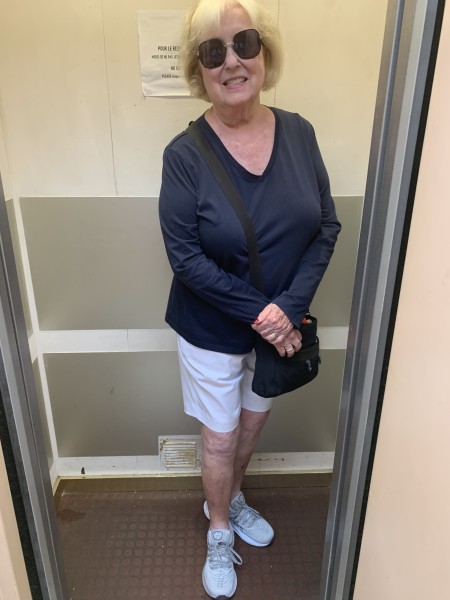 Karen the Navigator in the tiny elevator she discovered.
It’s not in the lobby. So what? In the rest of the world, people don’t—as we do—arbitrarily throw away perfectly good buildings; instead they repurpose and adapt them, preserving and honoring their architecture and history, valorizing a sense of cultural continuity. Among my favorite stories is one my father-in-law, Bill Cunningham, told. He was on a bus tour of southern England when his guide pointed out an old structure, saying it was built in 12. Bill raised his hand and asked, “1912? 1812? 1712?” She said, “No, 12.” But repurposing and adapting old buildings often results in awkward layouts, ungainly rooms forced into incongruous crannies, refrigerators and toilets sprouting in vestibules, elevators placed in dark hallways leading off ostentatious lobbies.
I push the elevators call button. It doesn’t light, but that’s no cause for concern; elevator-button lights are often burned out. But nothing else happens either. Then I see a sign taped to the elevator’s frame. Saying what? It’s in French. I am momentarily—and irrationally—irritated; then I explain to myself that having a sign written in French is not unreasonable in, you know, France.
I in fact have some French, although it’s one-way: I can formulate a coherent question. But when I ask a French person a question in French, that person answers in French, which I can’t understand to save my life. I clumsily translate the sign’s 15 or so words: The gist is that the elevator—l’ascenseur—has been hors de service since 18/08/2023. August 18th. Two weeks.
That’s two weeks so far. Anyone who spends time in France soon learns that, unlike tightly wound Americans, the French are not—how can I put this?—OCD about getting things fixed quickly. Or at all. If there’s a ditch, a French person will lay a board across it and then will ask—accompanied by a Gallic shrug—“You can cross, non? The problem is solved, n’est-ce pas?“ The French simply have a narrower definition of “broken” than Americans: “Can you somehow get it to work? Oui? So now it’s working. Non?“ French shrug.
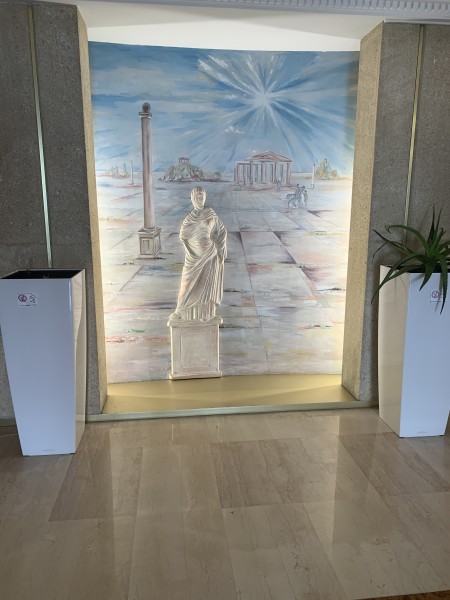 The type of statuette for which Le Tanagra is named.
A careful observer will note that shrugs are more complicated than is commonly understood. There is a global shrug taxonomy, every nation having its own distinct, national shrug (except Canada, where shrugging is considered impolite). Each nation’s shrug is a manifestation of its core outlook on life: Jewish shrugs convey irony; Italian shrugs convey what can I do fatalism; French shrugs convey a subtle condescension, an implication that shrugees should perhaps reconsider what is truly important in their lives and values.
A sentiment with which I generally agree. But here, confronted by the silence of the ascenseur, I’m starting to freak. I can neither call nor text anyone, nor have I internet access, because my phone isn’t connecting to a local carrier. A week before leaving home, I called Verizon and had them add a European roaming plan to both my and KtN’s phones. For some reason, my roaming hasn’t kicked in, but KtN’s has. She can make calls, send texts, and surf the internet. But her phone doesn’t have the Airbnb app that allows messages to be sent directly to our apartment’s owner. I attempt to install the app on her phone. I’m told that to install an App Store app, the phone has to be connected to wifi. (Grrrr.)
Here’s our situation: We can’t find, not to mention get into our apartment, we can’t contact the apartment’s owner, and we’ve texted his local agent, Sarah, who hasn’t responded. Am I going to have to manually lug our many bags up seven flights of stairs? Not to mention that KtN’s new knee isn’t ready for major stair climbs. Oh, this is not good. This is not good at all.
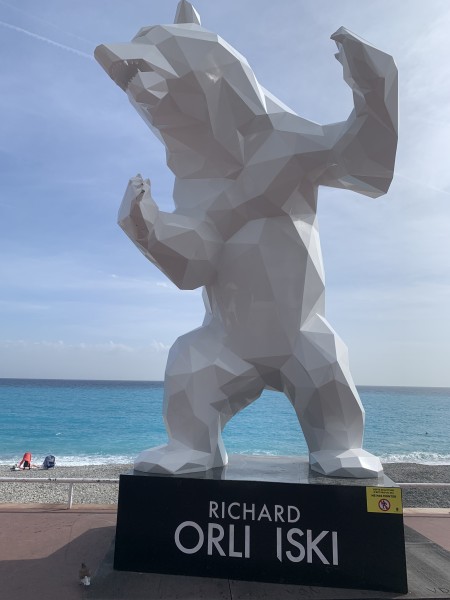 One of around a dozen of Richard Orlinski's giant metal sculptures of animals scattered around Nice. Notice the missing "N." (Shrug.)
While I’m paralyzed with angst and indecision, KtN goes exploring again, this time opening and passing through a dark door into a dark hallway. Again she calls out to me, and again I go to her. She’s discovered another elevator. It’s cage is the size of a broom closet, but any ascenseur in a storm, and this one has a lighted call button! I jump in and elevate to the 7th floor. When the tiny cage’s narrow doors open, I look to my right. Et voilà! There’s the apartment door exactly where it’s supposed to be! With a keypad! I de-elevate to get the luggage and KtN. The ascenseur is so compact that it holds only me and one or two bags; to elevate all the luggage takes three trips, then a fourth to bring KtN up. The small, 7th floor landing is now jammed with bags that I slalom through to get to the apartment door and its magic keypad. The third test vanquished, I gird my loins for the fourth and final trial: keying In the code. Once I’ve proved myself worthy, we will be granted access to the holy of holies, the sanctum sanctorum: The apartment. The bed.Except the code I have is six-digits, and what’s on the door is a four-digit cylinder lock. Now what? Maybe I drop the first two digits? Maybe the last two? Maybe I’m at the wrong apartment? No. There’s only one door to the right of l’ascenseur. Maybe there’s yet another elevator? Not likely. Maybe we’re in the wrong building? No. We’re in the only building on the Promenade des Anglais with this address. Maybe it’s a scam and there’s no apartment at all? That’s not unheard of with Airbnb.
For maybe the first time in my life I’m completely stymied. I’m not a person who gets stymied. I always think of something to try, even if it’s pointless, like moronically slapping a wall in case it might contain a camouflaged call button that might activate a trompe l’oeil ascenseur. But just now I have no idea how to proceed. I do know how not to proceed, however: Scratching at a stranger’s door at—by now—22:30 is a seriously wrong-headed idea. Though nowhere else in the world comes close to the circular firing squad into which the US has devolved, people here have guns too.
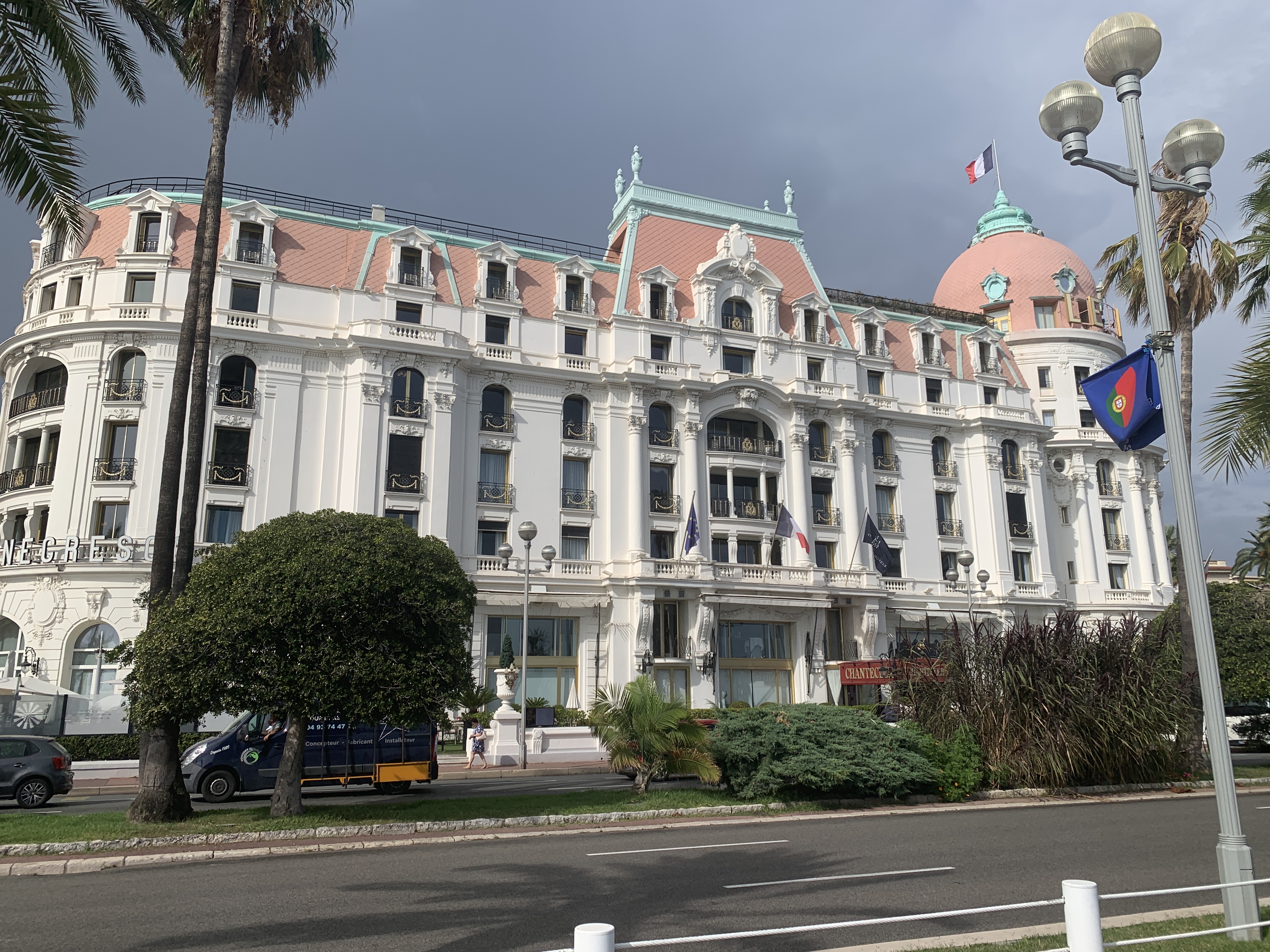
We still have not heard back from Sarah, but we can’t stay on the 7th floor landing indefinitely. So back down to the lobby we go. I de-elevate first our luggage and then KtN. We’re exhausted, and it’s stupid late. Nor can we stay indefinitely in Le Tanagra’s lobby. Maybe go to a hotel? A world-class hotel, the Negresco, is just four blocks down the street. We use KtN’s phone to check its rates. Assuming there is a room available—it’s the height of Nice’s tourist season—the room start at 1100 euro per night. Even in my altered state, I clench at the cost. Maybe we take a room for one night, get some rest, and provide ourselves with some time tomorrow to figure something out? Maybe rather than drag all our luggage down the sidewalk, we order an Uber to transport us and the bags four blocks to the hotel?
Just then the dark door to the dark room with the working ascenseur opens. A young man steps out. I raise a hand in simultaneous supplication and defeat. “Excusez-moi,” I say. "Parles-tu anglais?"
