


Viking’s tours sensitively grapple with the so-called “Final Solution” that sought to expunge the Jews from the planet
PART IV: REGAL REGENSBURG AND JUDGMENT’S TRIUMPH AT NUREMBERG
Stumbling Through Regensburg
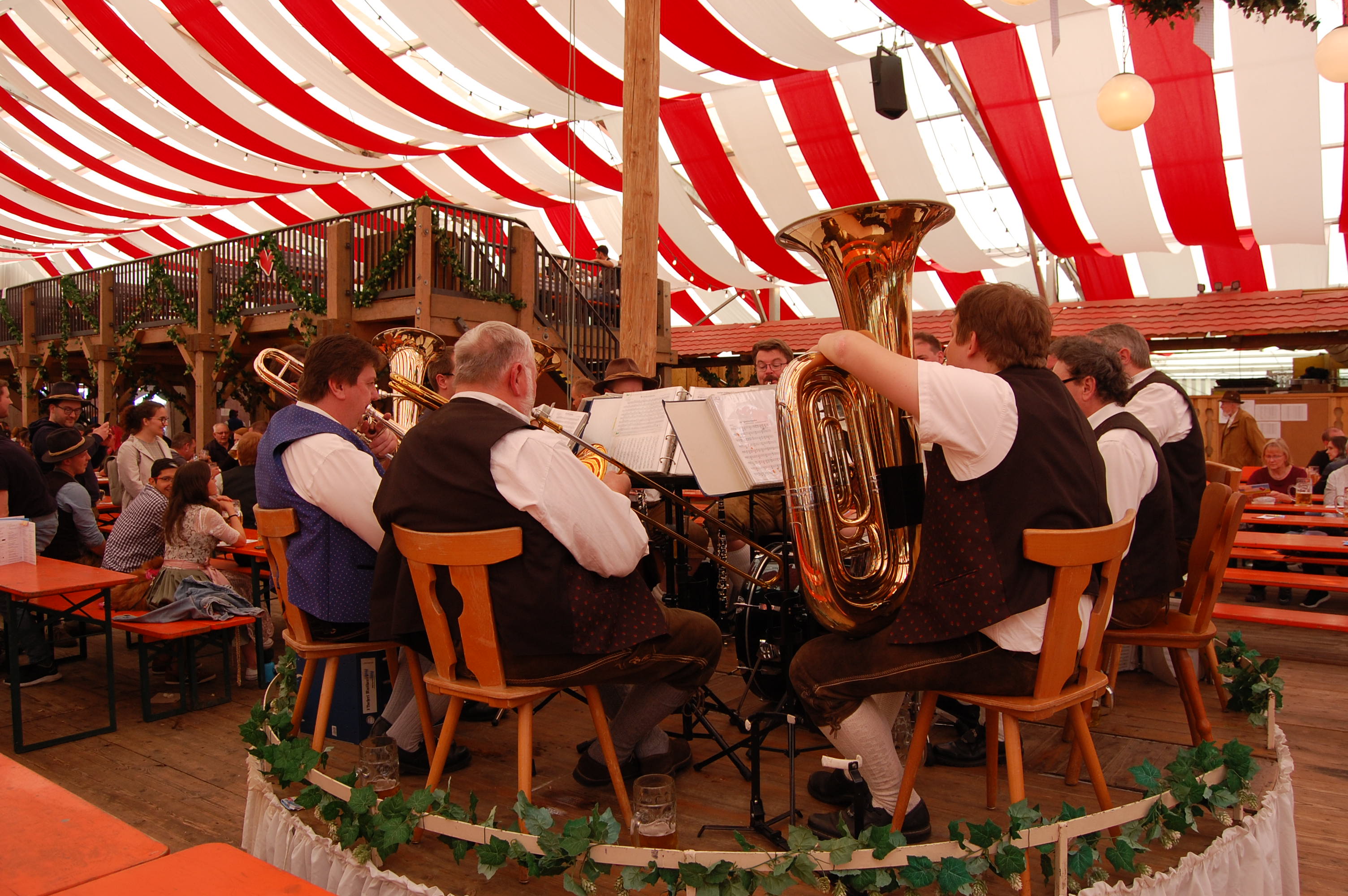
Viking’s Modi rolls into Regensburg, the oldest city on the Danube, which – having escaped devastation during WWII’s Sturm und Drang – is one of Europe’s best preserved Medieval enclaves, earning it UNESCO World Heritage Site status. A walking tour across its graceful old stone bridge into this lovely town, the birthplace of Pope Benedict XVI (Joseph Ratzinger), is mostly delightful. The Gothic twin towers of St. Peter’s Cathedral, completed by 1320, stretch 350 feet high. Beside the landing where the Modi is moored is an outdoor Oktoberfest-type carnival and celebration, with rollicking volks clad in traditional Bavarian dirndl and lederhosen, swilling gigantic beers from steins and mugs, as an oompah band blares brassy loud music that would have made Beethoven glad he’d gone deaf.
Inevitably, like at most other German places, beneath Regensburg’s picturesque façade and beer-fueled good times, is a troubling history, which our guide Manuela illumines during our city stroll. Outside a low-rise apartment house, Manuela points to a memorial plaque noting that German industrialist Oskar Schindler, who’d saved 1,200-plus Jews, had lived here from November 1945 to September 1946 with his wife Emily. By then, having depleted his fortune on rescuing his Jewish factory workers, the once-high living Schindler was destitute. Oskar, who’d be celebrated as a savior in Steven Spielberg’s 1993 Best Picture Oscar winner Schindler’s List, was reviled by Regensburg’s townsfolk as a traitor.
Monika also points out Stolpersteine, or “stumbling stones,” embedded amidst cobblestones in the streets. Etched into each 10 square centimeter brass block are details of the Holocaust victim’s life and death, implanted in front of his/her last known residence (of choice). The inscriptions on all 70,000 stumbling stones laid across Europe begin with the words “Here Lived,” followed by the casualty’s name. It is an assertion of a life that once was – defiance against the fascist obsession to obliterate from existence and memory all those non-Aryan “inferiors” Nazis considered to be “Untermensch,” or “subhuman.”
That night, it’s “Bye Bye Modi”: Because recent rains have made the river water too high, we must pack our bags and the following morning take a two-and-a-half-hour bus ride to board another identical Viking ship on the other side of low-lying bridges and locks, arriving in time for one of the most momentous excursions of our voyage through European space – and time.
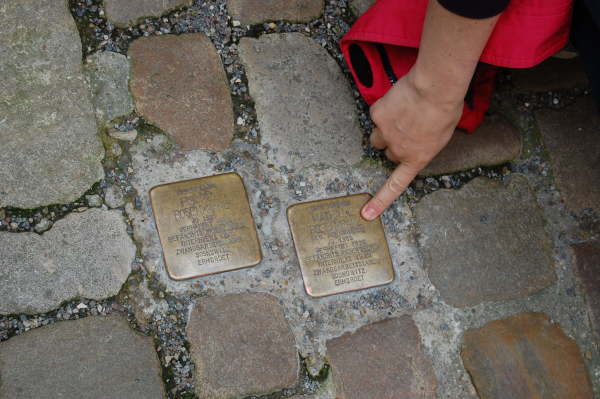 Tour guide Manuela points at brass "stumbling stones" in front of homes where Holocaust victims lived before the Shoah.
Triumph of the Swill
Viking’s tours sensitively grapple with the so-called “Final Solution” that sought to expunge the Jews from the planet; our guides and itineraries are no shrinking violets when it comes to facing the grim history of WWII and what led up to it in the “Fatherland” and beyond. Viking’s Skirner, named for a servant of the Norse gods, awaits us at Nuremberg (also known as Nürnberg), Bavaria’s second largest city, filled with the Gothic, Baroque and half-timbered architecture beloved by the half-witted Franconian fascists fleeing modernity, yearning to return to the Middle Ages. Nuremberg emanated those archetypal Aryan attributes Nazis were fanatically fixated on, so much so it was nicknamed “The most German of German cities.”
For this reason, after coming to power in 1933, Hitler and his cohorts chose Nuremberg as the site for their Nazi party rallies. These massive militarized displays of fascist fervor and furor for Der Fuhrer might be forgotten or a mere footnote to history if not for a movie. The Triumph of the Will may not have won the Mussolini Cup for Best Foreign Film at 1935’s Venice Film Festival, but like D.W. Griffith’s 1915 The Birth of a Nation, Will has unofficially been “inducted” into moviedom’s “Hall of Shame”.
This almost-two-hour (cut down from a longer version) National Socialist cinematic screed of screeching speeches by squealing Nazis intercut with the mass spectacle of faceless Hitlerian hordes has, like Griffith’s silent epic, the misfortune of being well-made. Leni Riefenstahl – a dancer and actress in Weimar Germany’s mystical Mountain Films, such as 1932’s The Blue Light (which she also directed) – lensed Will with a 150-person crew and 30 cameras, using innovative film techniques, including dynamic vistas shot from a specially-built elevator. Riefenstahl’s big budget production has great propagandistic panache, and at times Will’s vast fascist formations of goosesteppers resemble scenes choreographed by Busby Berkeley (a former parade conductor for the US Army during WWI) in MGM musicals. (Berkeley helmed Gold Diggers of 1935 the same year Riefenstahl made Will, which should have been monikered Grave Diggers of 1935.)
As a movie major at Manhattan’s Hunter College, I unwillingly had to view Will. (I remember asking: “Why do they say Hitler was such a great orator? I don’t understand a single word he’s saying.” A classmate pointed out: “You dummkopf – he’s speaking German.”) So, with great anticipation (and dread) I embark on Viking’s “Nuremberg World War II Tour” led by Patrick, a young German who’d studied history at university.
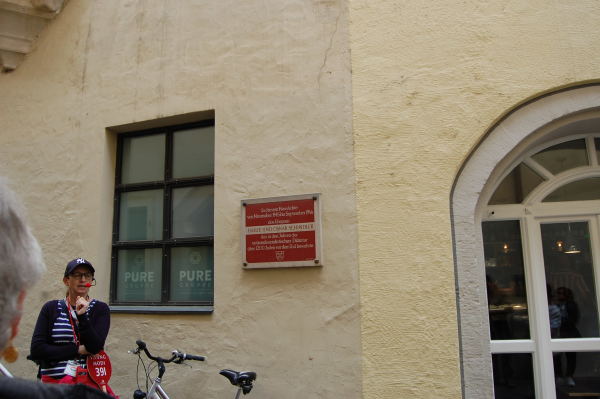 Our guide Manuela points out the memorial plaque outside the apartment house righteous rescuer Oskar Schindler lived in after WWII.
The bus drops us at Great Dutzendteich Lake, where well-prepared Patrick holds up images he’d collected in a notebook and unfurls a large picture of a Nazi rally. In front of us, across the lake, looms the Congress Hall, a structure for Nazi party gatherings intended to hold audiences twice the size of the Roman Coliseum. In stark contrast to the quaint Medieval style of Nuremberg’s buildings which fascists fetishized, Albert Speer and Hitler’s other architects built in a distinctly non-aesthetic monumental, mass mode. In any case, like the thousand-year Third Reich itself and so many other gestapo Big Lies, fantasies and pipe bomb dreams, the Kongresshalle was never completed. (Patrick informs us that the jackboots were lousy businessmen – rank-and-file Germans had to buy tickets for Party Congress activities where attendance was compulsory, and stiffed Bavarian vendors and shopkeepers.)
Behind us is Will’s piece de resistance – or, perhaps I should say, “set piece”? It is the Grandstand, where Hitler and other Nazi notables rather memorably (thanks to Riefenstahl) snarled their hate-filled, fanatical rants to the assembled “Sieg Heil!”-chanting thousands. (By 1936 the Zeppelinwiese was expanded to hold almost a third of a million people.) As a film historian/critic, I’ve always been fascinated by the difference between movie magic and reality and relish visiting actual locations depicted onscreen, but it’s blood-curdling to see the spot where Der Fuhrer spewed his madness.
Patrick says the Nazi rally site was actually a Zeppelin Field and that when Riefenstahl shot Will in 1934, the podium where Hitler harangued from was then made out of wood at the incomplete grandstand, subsequently rebuilt by Speer out of brick and concrete, faced with shell limestone. The cinematic secret to Riefenstahl’s Hitlerian homage, and why it’s been so noteworthy is that although the film’s raw material is apparently actuality, the veteran actress shot this carefully manicured and manipulated documentary as if it was a feature film with actors, script, production values, etc. The Little Corporal got the Hollywood treatment, like he was a movie star.
In it, Adolph descends from the clouds like a Wagnerian superhero, greeted and feted at Nuremberg with an outpouring of mass adoration that makes Beatlemania pale in comparison. You could imagine Der Fuhrer muttering: “My public! They adore me!” and ordering Riefenstahl which camera angle she should shoot his profile from. One can almost hear Riefenstahl declaring: “Lights! Cameras! Aryans!” and when the “action” stops, shouting: “Cut-throats!”
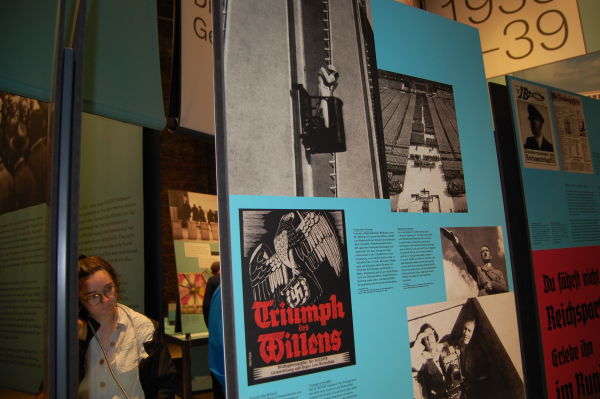 A photo mural about The Triumph of the Will at Nuremberg's Documentation Center includes a photo of "Hitler's favorite filmmaker," Leni Riefenstahl and a picture of the elevator the cameramen used to obtain those grandiose, sweeping shots of Nuremberg's Nazi Party rallies in 1934.
From the Zeppelin Field our bus carries Viking’s passengers to the other side of the lake to the Kongresshalle, the brownshirts’ largest construction project. Ironically, today the Congress Hall, which was never completed by the notoriously xenophobic Nazis, is headquarters of the Federal Office for Migrants and Refugees for contemporary Germany, now Europe’s biggest host country for asylum seekers and other displaced persons. The onetime Congress Hall also houses the Documentation Center, a museum currently being remodeled that’s presenting an interim exhibition with artifacts, photos, wall texts and film clips chronicling Nazi rallies.
Of greatest interest to this film historian is screening scenes from Star Wars and Disney’s animated The Lion King, comparing their mise-en-scène to that of The Triumph of the Will. Leni Riefenstahl used to complain that if she had been allowed to collect royalties for usage of material she shot for Will (not to mention movies that copied her mass movement and formations) she would have been rich. All I can say to “Hitler’s favorite filmmaker” is “boo-fucking-hoo!”
Judgment Day at Nuremberg
A far better film set in that “most German of German cities” is Stanley Kramer’s 1961 Judgment at Nuremberg, a feature that opens with dramatic documentary footage of the gigantic marble swastika above the Zeppelin Field’s grandstand where Der Fuhrer once mesmerized the masses being blown up, following the US Army’s April 22, 1945 victory parade. Kramer’s masterpiece dramatizes the Nuremberg Tribunals, wherein Nazi war criminals were tried for their endless atrocities, similar to the real-life trials that took place 1945-1949 in Courtroom 600 of Nuremberg’s Palace of Justice on Fürther Strasse.
Our guide Patrick explains selection of this site for the International Military Tribunal was mainly because the prison was adjacent to the courthouse, so Nazi defendants would have limited public exposure that could trigger unrest. In addition, the courthouse wasn’t severely damaged during the war and was large enough for officials of the four Allies and press. These practical considerations were the deciding factors in choosing this space, not that Nazi rallies took place and the infamous anti-Semitic “Nuremberg Laws” were announced here.
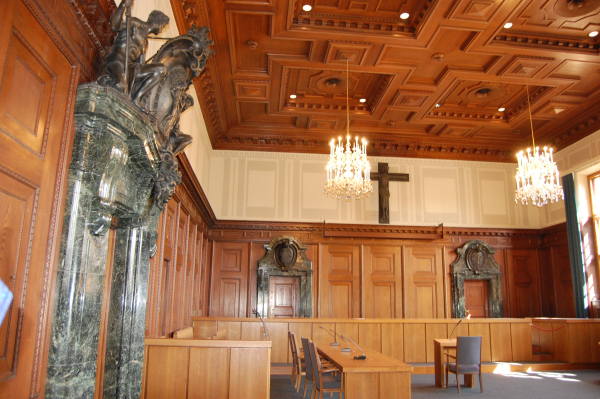 The world renowned Courtroom 600, where Hermann Göring and other Nazi leaders stood trial for war crimes and crimes against humanity.
We spend an hour-plus in Courtroom 600, where a film is presented and knowledgeable Patrick speaks at length about what transpired during the Tribunals. We’re shown where the judges were ensconced, the witness stand and press box located and defendants seated, including exactly where the Luftwaffe’s commander-in-chief Herman Göring – the most prominent Nazi tried at Nuremberg – sat during the 218-day trial. On September 30, 1946, Göring was found guilty on four counts, including war crimes and crimes against humanity, by the Tribunal, which proclaimed: “His guilt is unique in its enormity. The record discloses no excuses for this man.” Göring cheated the hangman’s noose by swallowing a cyanide capsule, joining the countless others in the “night and fog” he’d condemned millions to.
During the course of his highly informative talks, Patrick mentions that Nixon’s National Security Advisor and Secretary of State Henry Kissinger was originally from near Nuremberg, which he fled in 1938 shortly before the Nazi juggernaut butchered most German Jews. When our bus drops us off at Viking’s Skirner, I ask Patrick: “Do you know what Kissinger’s existential angst was?” Patrick shakes his head and I quip: “He wanted to be a Nazi, but was born Jewish.” Patrick frowns, saying, “That’s mean.”
Imbued with the Nuremberg Tribunals’ spirit and annoyed the 100-year-old and other war criminals have avoided accountability, I reply: “Not nearly as mean as what Kissinger did to the Vietnamese, Cambodians and Chileans.”
SIDEBAR:
VIKING:
For reservations or information, call a Viking Expert at: 1-800-2-VIKING (1-800-284-5464) or see your Travel Advisor | viking.com. Reservation Hours (Pacific Time) Sun–Sat 5:00 a.m–7:00 p.m.
DESTINATIONS:
