

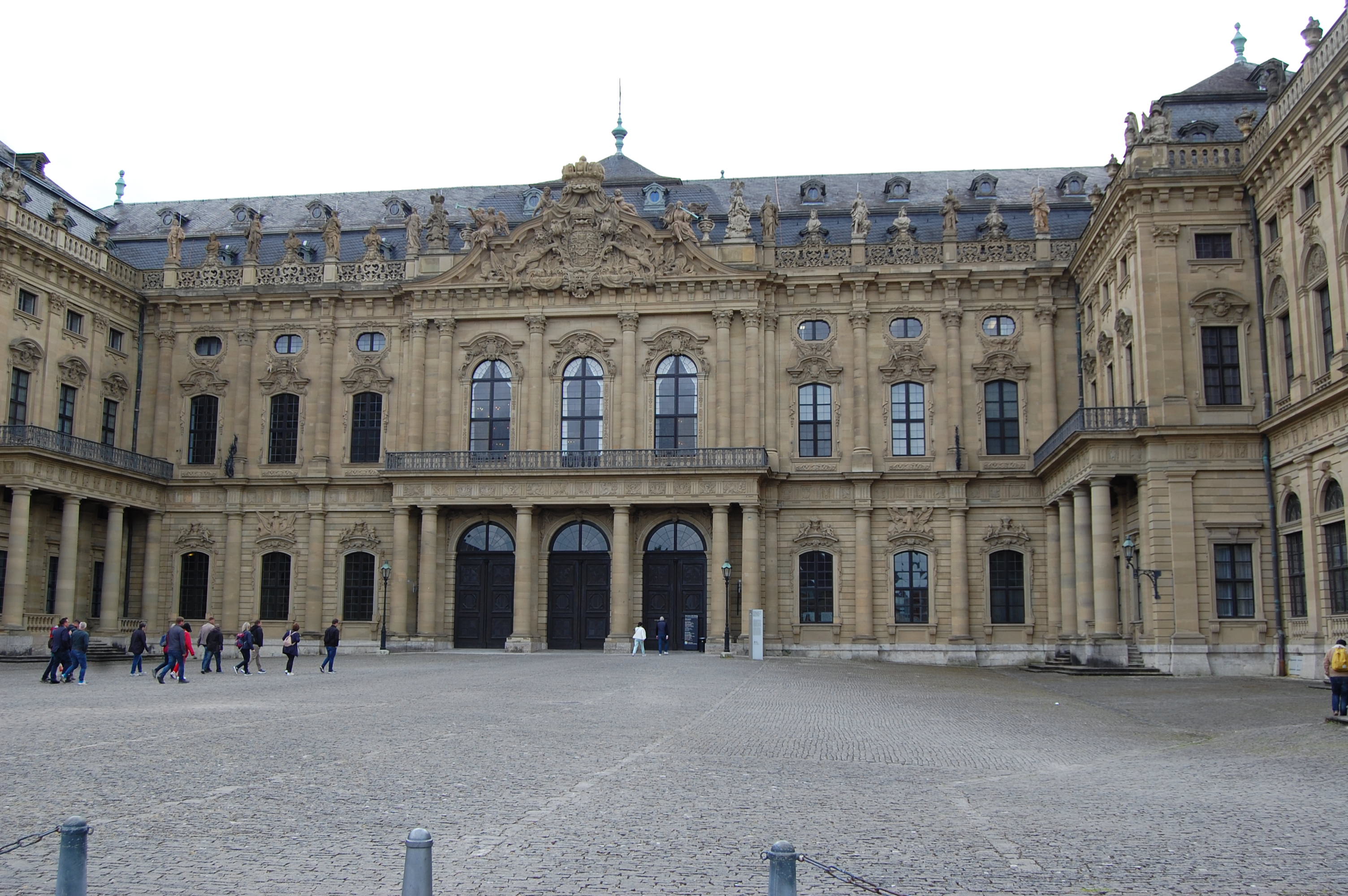


This Upper Franconia outpost is marking its 30th year as a UNESCO World Heritage Site, a very well-deserved designation for being so well-conserved.
PART V: BAMBERG TO WÜRZBURG
Gamboling Through Bamberg Preserved
Largely spared Allied bombing during WWII, the Bavarian township of Bamberg is a splendid center of central European medieval architecture and layout. So much so that this Upper Franconia outpost is marking its 30th year as a UNESCO World Heritage Site, a very well-deserved designation for being so well-conserved. Bamberg’s most singular structure is its unique Old Bridge Town Hall, originally built circa 1386 then rebuilt after a fire in 1460 in the middle of the Regnitz River’s left fork. This Town Hall was constructed on a manmade islet in the Regnitz, and linked to both banks of the river by two bridges.
According to legend, the reason for this odd placement of the Town Hall was that the Bishop, who was the head of this ecclesiastical State of the Holy Roman Empire, Bamberg’s Prince-Bishopric, was, well, a real prick who refused to allow residents either any land at all for the building site they’d originally requested for their municipal building. By building the Town Hall overwater on an artificial isle instead, the townsfolk presumably ran an end run around the Bishop’s land ownership monopolization.
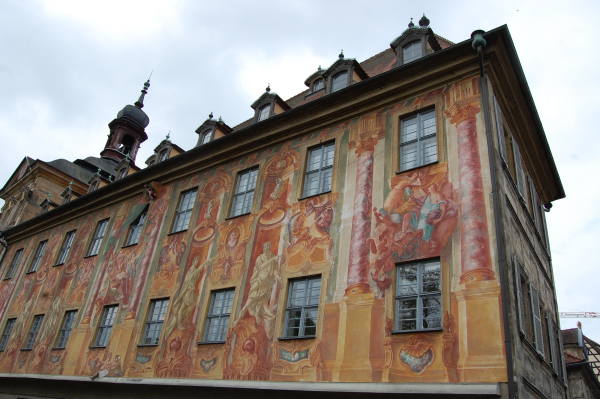 Johann Anwander's colorful mural decorates the Town Hall's walls with public art.
A tall half-timbered extension called the Rottmeisterhäuschen was added by 1668 and the baroque gate-tower is extremely ornate, including a coat-of-arms depicting St. George as a knight. Fresco murals with a rosy palette in trompe l’oeil style painted by Johann Anwander circa 1755 adorn the Old Town Hall’s walls. The ancient power struggle between the Bishop and the people resulted in a beautiful building that today serves as a museum.
Our tour guide Noomi, a history major in this college town, leads us through cobblestoned streets lined with half-timbered homes, as if we are going back in time to the Middle Ages. This Bavarian enclave is known for 11 breweries (for a population of only 80,000) and Rauchbier, a special beer bearing a unique smokey flavor derived from malted barley dried over an open fire. Outside of one watering hole I spy an old fashioned, detailed metallic shop sign extending above the doorway which includes what appears to be a lion, the figure of a man inside of a wreath, a lantern emblazoned with the word “Rauchbier,” the number “1405” (which probably refers to the date this place opened, not its address) and what looks a lot like – of all things to find in Germany – a Jewish star.
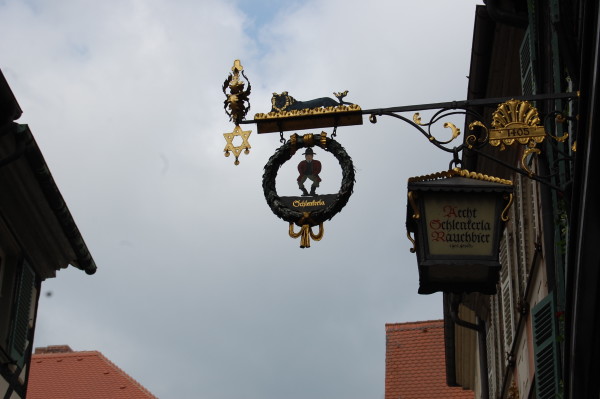 In those days before mass advertising, brewers identified their places of business with symbols that resembled the Jewish star.
Surprised, I ask Noomi about it, and our knowledgeable guide explains: “Outside a brewery they hang this sign that looks like a Star of David – but it means it’s a brewers’ star. So, the Nazis never removed them.” Alas, Bamberg’s Jews weren’t so lucky. “There were 1,000 Jews living in Bamberg before World War II,” Noomi says. “500 escaped to England and other places. The 500 who remained were all killed” in a town, which Noomi tells us: “When the synagogue was built in 1910 it was opened by the mayor who said he’s proud that all people live together in Bamberg… But during Kristallnacht [a date of great Nazi barbarity against Jews in 1938] the synagogue was burned down… The synagogue was rebuilt in the 21st century and about 600 Jews now live in Bamberg.”
One of the Jewish families that had migrated – long before the Holocaust – were the forebears of Louis Bamberger, who was born in Baltimore in 1855 and grew up to co-found a prominent department store chain on the East Coast named “Bamberger’s.” Noomi, too, has her own claim to fame – because of its picturesque setting, Bamberg has been the location for many movie shoots, and Noomi appeared in the 2011 version of The Three Musketeers with a European cast including Christoph Waltz as Richelieu, Mads Mikkelsen as Rochefort, Milla Jovovich as Milady de Winter, Orlando Bloom as Duke of Buckingham and our illustrious tour guide as an extra.
Palace Envy: Whirling Through Würzburg Restored
Just as Schönbrunn is Vienna’s wannabe Versailles, the Würzburg Residence is Bavaria’s entry in the Euro-sweepstakes to compete with and emulate that magnificent palace built outside of Paris by France’s Sun King in the 17th century. Würzburg is to conventional chateaus what Wurlitzers are to ordinary organs. Surrounded by Germany’s largest vineyard, this 300-room Baroque Residence with four floors commissioned by Würzburg’s Prince-Bishop in 1720, expresses in architectural terms that haughty haute couture motto “Dress to impress.”
“Absolutism is all about showing off, prestige,” our guide Bella tells us, adding that original chandeliers made out of Venetian crystal, weighing 330 pounds each, were transported all the way from La Serenissima to Würzburg. How did the fragile glass survive the trip of hundreds of miles by ship and carriage unbroken? The chandeliers were encased inside of melted bee wax inside of crates. Upon arrival, the bee wax was melted and then ostentatiously hanged to provide lovely light for the patricians.
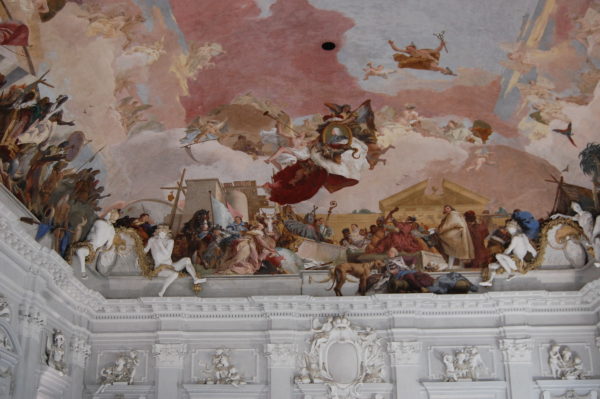 Giovanni Battista Tiepolo’s Allegory of the Planets and Continents, the world's largest continuous fresco mural, is a technical masterpiece marred by Eurocentrism.
Bella goes on to say, “Horses would enter into the Grand Hallway. It would take three hours to go upstairs,” because of the intricate greeting rituals and protocols. “The Prince-Bishop would come out to greet carriages – if they were important enough.” Well, la-de-dah! Needless to say, we mere passengers of Viking’s Skirner didn’t merit such a resplendent reception by any Bavarian absolutists, but we had Bella, whose historical and cultural expertise absolutely elaborated upon the rarefied sights we beheld in what has been a UNESCO World Heritage Site since 1981.
Palace Propaganda al Fresco
No grand palazzo is worth its weight in gold without incorporating artwork along with its stately structures. Of course, the Würzburg Residence does offer lots of art, but its crown jewel is “the largest continuous fresco mural in the world,” says in-the-know Bella. As one ascends German architect Johann Balthasar Neumann’s Baroque grandiose entrance staircase, about 75 feet overhead looms Venetian painter Giovanni Battista Tiepolo’s Rococo masterpiece, Allegory of the Planets and Continents, completed in 1753. Although the Greek god Apollo is depicted in the 7,287 square foot mural, unlike European medieval art, the fresco’s symbolism has more of a political meaning than a religious significance per se, transcending the Greco-Roman pantheon and Christian theology.
The corniche of Tiepolo’s sprawling imagery indelibly daubed across the Würzburg Residence’s much-vaunted vaulted ceiling depict four continents: Asia, Africa, America and Europe. An entire article – if not a book! – could be written about this colossal work of art. But what stands out is the 18th conception of what would later be called the Third World, vis-à-vis the First World. While Asia, Africa and America are represented as being in various degrees of barbarity, Europe appears as the crown of creation, the center of the universe. Wearing a feather crown, Lady America is topless and riding an alligator; Lady Africa is atop a camel; Lady Asia rides an elephant; while Lady Europe is berobed in silks and sitting upon a throne.
Tiepolo fancifully takes a stab (or daub) at rendering animals he’d never seen, with outre results that tickle our 21st century orbs. In any case, Allegory of the Planets and Continents is literally Eurocentric, an 18th century visualization of white supremacy. The world’s biggest continuous fresco arguably shares something in common with D.W. Griffith’s 1915 Civil War-era epic The Birth of a Nation, a big picture of the silent screen: Great artistic form marred by racist content.
According to Bella, “Every painting, every statue has a message… Tiepolo dedicated his Allegory to Prince Bishop Karl Philip von Greiffenklau – who appears in the fresco – and saw himself as a deity.” But of course!
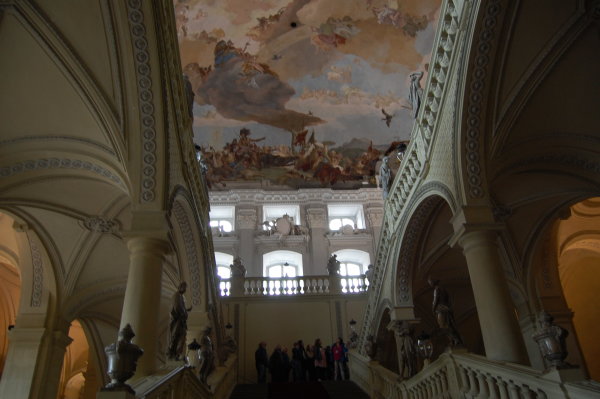 Johann Balthasar Neumann’s stunning staircase leads up towards an awe-inspiring fresco mural.
Our guide adds that “the town of Würzburg was firebombed by the Allies on March 16, 1945. 90% of the buildings were destroyed and 5,000 people died” in only 20 minutes. Portions of the Residence, that monument to Germanic superiority, were bombarded, including the much-vaunted Mirror Cabinet, built from 1740-1745, in the Southern Imperial Apartments. Almost 70 years later, the entire complex – now administered by the Bavarian Palaces Department – has yet to be completely rebuilt, and only 40 of its 300 rooms have been restored and opened to the public.
But those that have been refurbished include White Hall. In addition to the chandeliers hanging in the White Hall, another Italian import was Antonio Giuseppi Bossi, the court plasterer, renowned for his Rococo stucco. Bella describes him as both “a genius and a lunatic.” In nine months throughout 1744-1745 Bossi obsessively worked without any apprentices on the stucco in the White Hall, in order to complete the decorations before the arrival of Maria Theresa, to impress the Empress. Exhausted by her long sojourn to Würzburg, the Arch Duchess of Austria entered the newly finished and furnished White Hall, but Maria Theresa was too tired to so much as notice the artist, let alone his stucco masterwork, causing Bossi “to go nuts,” Bella says.
The Residence’s other restored rooms open to visitors display a painting depicting Hannibal; a tapestry of Alexander the Great; Asian porcelain figures atop a fireplace mantle; and in the Tuscany Rooms a quaint carousel, which Grand Duke Ferdinand III of Tuscany had made for his children in the early 19th century, when the former Prince-Bishopric of Würzburg was a secular Grand Duchy.
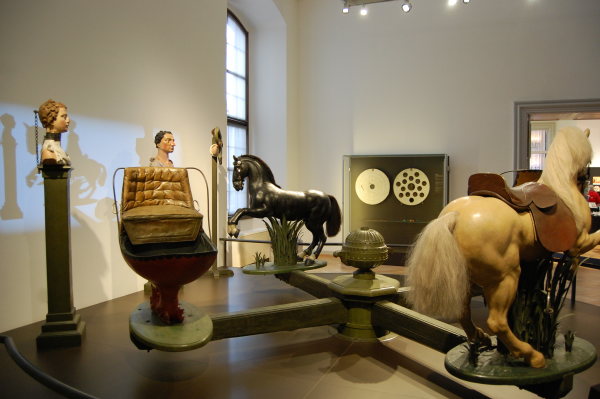 A Grand Duke had a carousel built for his children way back during the Napoleonic Era. Bonaparte slept 3 times in the Würzburg Palace, which he called "Europe's largest parsonage."
Monumental Man
The Royal Air Force may have pummeled Würzburg in 1945, but much of what’s left of the Residence is largely thanks to John D. Skilton, who earned an M.A. at Yale in 1936, was an art historian at Washington’s National Gallery of Art and became a US Army officer during WWII – and one of the so-called “Monuments Men,” devoted to saving as much human culture as possible from the ravages and carnage of war. According to John D. Skilton:
“Skilton was responsible for the survival of the treasured Tiepolo ceilings of the Kaisersaal at the Würzburg Residenz… After extensive Allied bombing on March 16, 1945, the palace’s wooden roof collapsed, leaving Tiepolo’s [Allegory of the Planets and Continents] exposed to the elements. For several weeks, Skilton collected lumber to repair the roof. He eventually found a stash of logs near Ochsenfurt, which he floated down the Main River to Heidingsfeld. After personally financing a sawmill to cut the logs, Skilton supervised a team of German architects, engineers, and laborers who worked diligently to repair the roof before rains could destroy the magnificent ceiling. The project… was not completed until 1987.”
SIDEBAR:
VIKING:
For reservations or information, call a Viking Expert at:
- 1-800-2-VIKING (1-800-284-5464) or see your Travel Advisor | viking.com Reservation Hours (Pacific Time) Sun–Sat 5:00 a.m–7:00 p.m.
DESTINATIONS:
- Bamberg
- Würzburg Residenz
