



One morning soon after we met, Ted grinned at me and said, “Let’s go on a trip...where do you want to go?”
Jonye: Ted is 85, I am almost 84, and we just traveled around the world. No, we haven’t known each other for years. I lost my other half in 2022, Ted lost his other half in 2023, and we met on Silver Singles. The four months I spent writing and talking to men who are alive, breathing, and men constructed by overseas scammers to attract women and cajole them into sending money were considerably more difficult than traveling around the world with a man I had known for only one year.
Ted: Can a couple in their mid-80s circle the entire world together? Jonye is a world traveler, a breast cancer survivor, and a soon-to-be-published author whose book (“Breast Cancer: Am I More Likely to Be Alive in Ten Years with Treatment or Without?”) will be out soon on Amazon. Jonye recently travelled to Tanzania to follow the migration through the Serengeti, and to Uganda and Rwanda to commune with the mountain silverback gorillas.
Jonye: Ted is a retired lawyer, political commentator, explorer, mountain climber (in his youth), filmmaker and world traveler who has visited 75 countries, including Shangri-La. One morning soon after we met, Ted grinned at me and said, “Let’s go on a trip...where do you want to go?” We talked about where to go at most for two days, and then Ted was off planning the trip. We spent two weeks exploring the volcanos and jungles of Costa Rica…a couple of months after we met.
Ted: So off we go on our latest excursion, which will take us around the world starting in LA. We first contacted Jordan at topbusinesstravel.com, and worked with him to determine our route Around-the-World (ATW). We decided to book business class on long haul routes, and economy class on shorter, daytime routes. Once we booked all the flights through Jordan, we filled in what we wanted to do at each stop. We planned to travel 20,000 plus miles over 44 days at 19 locations. Can we, do it? We decided that at our ages we needed Rest Days interspersed with the travel and tourism days. Are we doing this right?
Jonye: We are “old” and expected to take a tour or a cruise. Once we joined our tour group or boarded a ship everything would be taken care of, and we wouldn’t have to worry about a thing. We, however, didn’t want to spend our time sleeping in a hotel room just like an LA hotel room, making certain our suitcases were packed and outside our door by 6:00 am, peering out of a tour bus window, or following the flag of a tour guide anxious to keep us together.
Matterhorn in Switzerland; on camels at the Pyramids
Paris
Ted: First stop was Paris, for a triennial gathering of an American patriotic organization I am a member of. My experiences at this event are spelled out in the LA Progressive article on “The Terror of Trump”, published on in June 1, 2025. We also spent quality time with an old law school friend and her composer husband, who live near the Eiffel Tower.
Jonye: Ted’s law school friend and her husband are some of the loveliest people I have ever met, and I hope to spend more time with them. They found us a hotel right around the block from their elegant, mid 1800’s apartment. On the fifth floor, their apartment flows around a corner with high windows, intricate moldings, and herringbone parquet floors. The location, a few blocks from the Seine is excellent, and the price, around $300 per night, seemed reasonable. We didn’t check the hotel out; we just booked it.
Our room was barely bigger than the queen-sized bed. The bathroom door opened out into the room and could not be fully opened before it bumped into the bed. The shower stall was so narrow that a 6”1’’ man weighing 190 ponds (Ted) couldn’t bend down and pick up the razor he dropped. The shower door had to be shut to access the toilet.
Ted: We visited the outstanding David Hockney retrospective exhibit at the ultra-modern Louis Vuitton Pavilion. It is one of the best art collections exhibits we have ever visited. Hockney was deeply involved in putting the collection of his paintings and films together.
Jonye: We both like to walk, and we both like to read maps. Paris is a wonderful place to walk, and we are both accustomed to using the Paris Metro System. Ted was inspired to use Uber whenever we got tired, and it worked like a charm.
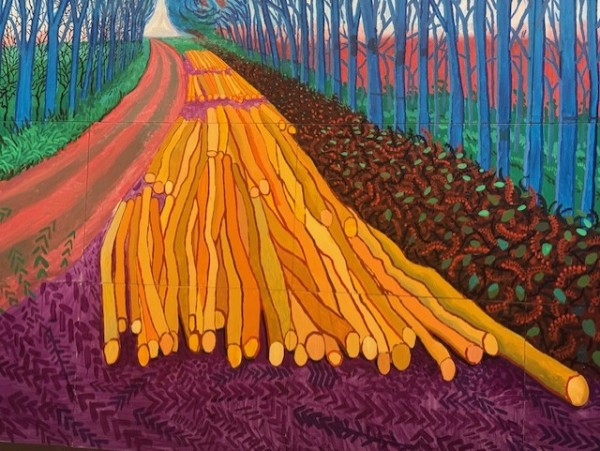 David Hockney
The Alps
Ted: We decided to travel by train to the Alps of France and Switzerland, visiting my old mountaineering haunts. The Aiguille du Midi in Chamonix, France was our first stop, an amazing group of structures thousands of feet above the Mer de Glace in the shadow of Mt. Blanc, Europe’s highest peak. The weather was below freezing, but we were dressed for it and gloried in the beauty and majesty of our surroundings.
Next were four trains to the classic Swiss alpine town of Zermatt, in the shadow of the Matterhorn, which I had climbed years before. We took a cable car to the summit of a nearby peak, and studied the history of mountaineering in the Alps, which began in 1860’s.
Jonye: Changing four local trains was not difficult, because the stations are small and clearly laid out. However, many times there were only 5 or 10 minutes between trains, and that made us a bit anxious. We discovered 5 minutes was plenty of time. Sometimes we just walked out of our train directly across a platform onto another train.
The rub is that 10 minutes is not enough time to get something to eat, and food Is not sold on local trains. After changing four trains in rapid succession, I was pretty hungry. Next time I will check the train schedule and bring a baguette if need be. I want there to be a next time. Riding on a train thru the French and Swiss Alps is a wonderful experience.
Ted: We travelled by train to Zurich, after mailing home our cold weather clothing, and flew to Cairo. We discovered that we brought too many clothes, and our two suitcases and two backpacks were too much for us old folks. We had to shed some stuff to survive this trip. And where we were going next it would be HOT…
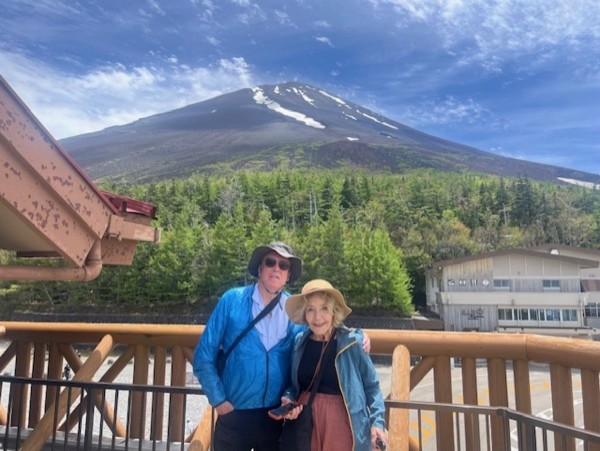 Mt Fuji.
EGYPT
Jonye: We rode camels to look at the pyramids, and we climbed ladders and ramps to the King’ chamber inside the Pyramid of Khufu, but our biggest Egyptian adventure was crossing the street. In Cairo, the only corners where the traffic completely stopped for pedestrians were controlled by a traffic cop. Yes, sometimes there was a signal at the corner. The trouble is that the signal only stops the through traffic. The signal has no effect on the continuous flow of traffic turning right directly in front of any pedestrian brave enough to step off the curb. Friendly Egyptians taught us hand signals to use to motion to oncoming traffic, and we plunged in and tried it ONCE.
Ted: We had no idea that in Egypt we would experience temperatures of almost 120 degrees (when we arrived at Aswan), 90 degrees warmer than what we experienced in the Alps. In Cairo, we rode camels in the shadow of the Pyramids (picture) and then made the mistake of tunneling up to an empty chamber inside the Khufu Pyramid. We were squeezed beside people descending the tunnel in the intense heat, and Jonye injured her leg in the process.
Her leg bothered her throughout our time in Egypt, which involved a flight to Aswan Dam and a trip down the Nile River to Luxor on a small cruise ship (thankfully air conditioned). We also were burdened with a “tour guide” who displayed a dislike for women that alienated Jonye. But when we reached Luxor, we said goodbye to him, and settled into the Sofitel Winter Palace Hotel, built in the 1880s and the place where Agatha Christie wrote her masterpiece, “Death on the Nile”. These were wonderful Rest Days, punctuated with a blisteringly hot visit to the Valley of the Kings and King Tut’s tomb, and a forgettable nighttime visit to the Karnak Temple, complete with a corny soundtrack.
Jonye: I loved staying at the Sofitel Winter Palace where it is possible to crawl into the luxurious, restful environment of 100 years ago, for a cost of less than $200 a night. If I had this trip to do over again, I would skip Aswan, skip the boat down the Nile, stay at the Winter Palace, and visit the attractions on the east and west banks from there.
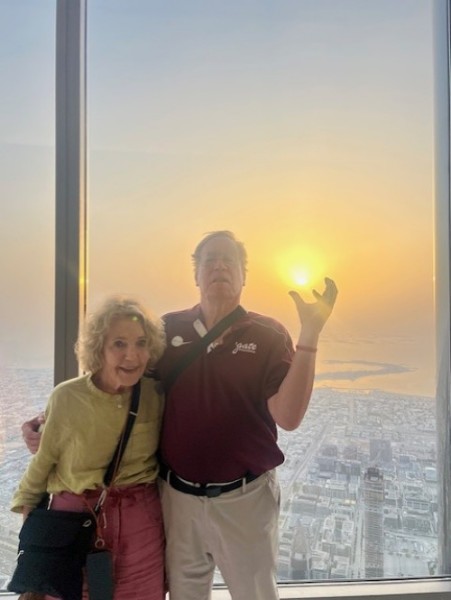 On the Burj Khalifa in Dubai
Ted: Back in Cairo, it became clear that Jonye’s leg needed attention. A business associate of one of my daughters, Hibaaq, who lives in Cairo, was able to get her an appointment with an orthopedic surgeon on a Saturday night. His clinic was open for business that night, amazingly, with many patients there to be treated. The doctor thought Jonye might have a stress fracture in her leg, and sent her to have it X-rayed, at a nearby place also open for business at that hour. Thankfully, it turned out not to be a fracture, but a muscle strain. Ahmed, Hibaaq’s assistant, compassionately provided her with a cane he no longer needed. She used it throughout the rest of our trip.
Jonye: I am very impressed with the efficiency of the Egyptian health care system. The orthopedist was matter of fact, friendly, and accessible. His office was very busy, much more casual than any orthopedist office in LA, and a comfortable place to be.
We had to drive to another location for x-rays where it took about an hour from beginning to end for the x-ray to be taken and sent to the Orthopedist. Very soon thereafter, he texted no fracture along with some prescriptions. At Midnight the pharmacy was open and busy in a location that looked very much like Century City. We had eaten dinner nearby, and it was very much like eating dinner on a warm evening in LA except for the people sitting around smoking hookahs.
Dubai
Ted: The pop-up city of Dubai, across the Persian Gulf from Iran, is probably not a great place to be right now, with Israel and the U.S. recently bombing Iran, but we visited it briefly. Hot and smoggy, and filled with skyscrapers it showed us nothing. We went to near the top of the Burj Khalifa, the world’s tallest building, just to say we had done it. (picture). Happy to leave…
Jonye: Imagine a brown/grey sky of smog meeting up with a vast expanse of brown/grey sand and no trees. Imagine a skyscraper hotel pretending to be luxurious with a loud, noisy, mediocre, buffet breakfast, and only a fast-food restaurant and bar for dinner. There are no restaurants for dinner within walking distance. In fact, nothing is within walking distance. You are out in the middle of nowhere surrounded by dirt and sand and a few other tall buildings.
Downtown has some of the most entertaining architecture anywhere, but downtown is more than a half an hour away on an uncrowded 12 to16 lane freeway. We paid almost $250 to take an elevator up to the 148thfloor of the world’s tallest building, and we got a great view of skyscrapers surrounded by smog. I have seen many lovely pictures of Dubai, and I expected it to be beautiful; it wasn’t.
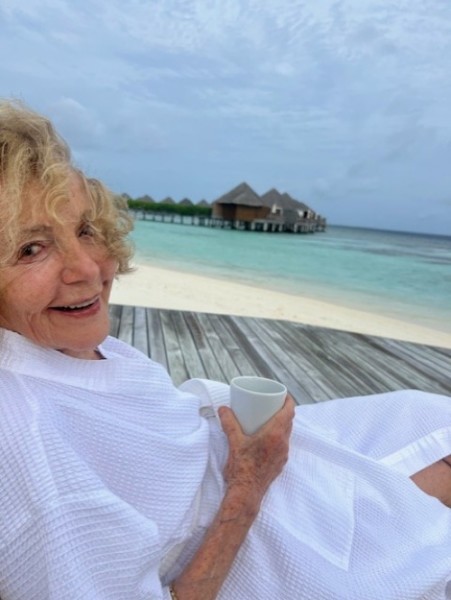 The Maldives.
The Maldives
Ted: Next was a six-day visit to the Baros Resort, located on one of the thousand-plus islands in the Maldives, a country in the Indian Ocean south of India and Sri Lanka. It is known for the world class snorkeling and diving, and we spent a lot of time in the warm turquoise waters surrounding Baros. A highlight was being caught in a driving rainstorm while snorkeling, with the sea water warmer than the rain. Using the Internet, Jonye found Baros among the over 100 such resorts on the islands of the Maldives, and it was the right choice, a wonderful Rest Week. (picture)
Jonye: The Baros resort occupies its own island, which is small and flat, and we could easily walk around it. The island is surrounded by a coral reef, and you can literally walk out of your cottage into the reef. We snorkeled inside and outside the reef most of the way around the island. The coral and fish were colorful, and the occasional shark had no interest in us.
The resort has over the water cabanas, but it can be scary to be in an over water cabana during a thunderstorm. We had a lovely cottage with a high thatched roof, a covered patio, and a private strip of sand out to the water. My favorite part of the cottage was the outdoor bathroom. Half of the bathroom was covered including a shower, but the other half was open to the stars with an outdoor shower surrounded by plants.
The resort has a good chef, and on many evenings, we could dance to the music of a small band. I would love to go back.
Japan
Ted: After a transit hotel night in the Kuala Lumpur airport, we reached our last stop, Japan. This was Jonye’s first visit (my 8th), and we started our 14 day visit in Tokyo. We again decided to travel by rail, and Japan has many excellent and very accessible trains. We got “JR passes”, which enabled us to travel through the central Japanese island of Honshu with ease. We “climbed” Mt. Fuji (all the way to a place past the Fifth Station on the peak), where we participated in a volcanic eruption drill (the last eruption occurred in 1716, but you can never be prepared enough).
Jonye: The first thing I noticed about Japan was that I didn’t know how to flush the toilet.
I had to open the door of the stall and ask the next lady in line at the airport what to do. I was staring at a confusing array of buttons on the toilet, a button for spraying one opening, a button for spraying the other opening, a button to increase the spray pressure, a button to decrease the spray pressure, and one to turn off the spray. The button to flush the toilet was on the wall.
The second thing I noticed was the exceptional friendliness and helpfulness of the people who live in Japan.
We were sitting on a local train returning from Mt. Fuji and not at all certain how to make the next connection. We had tickets to board a bullet train to Kanazawa. Our train ticket said our destination was Shinjuku station, but we needed to be in the Kyoto station to make the connection.
A Japanese woman dressed entirely in white sat down next to me. I was thinking how beautiful she was and asked her if we were headed toward the Tokyo station. She didn’t speak English, but vigorously shook her head yes. A few minutes later, she used her phone to translate Japanese into English and asked if I would like help. YES
When we got to the Kyoto station, she got off the train with us and motioned us to follow her. She went around the station asking directions and did not leave us until we were headed toward the correct platform.
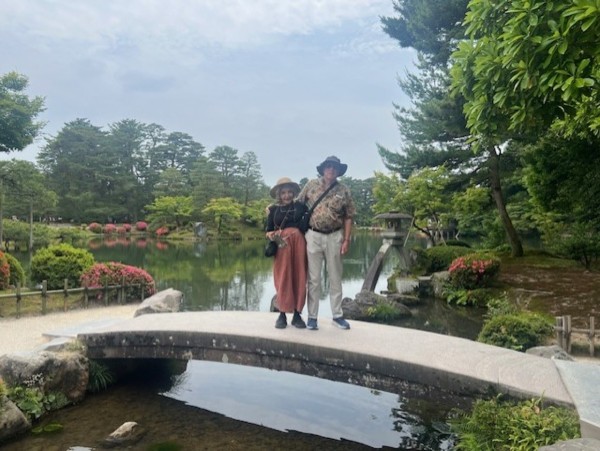 Park in Kanazawa
Ted: The city of Kanazawa, on the north coast of Japan, is a little Kyoto, and an art colony with a magnificent garden and restored pagoda. (Picture). Next was the magical city of Kyoto, finally free of its crowds from April’s cherry blossom season.
We were getting tired and slowing down after a month on the road, and we spent a lot of time at a beautiful onsen, a ryokan hotel with nude bathing in the men’s and women’s separate hot spring.
Jonye: The third thing I noticed about Japan is the excellence of the train system.
You can easily go almost anywhere on a train. We went, for example, from Kyoto to stay at the Jokiin Monastery high in the mountains in the small village of Koya-san, and then onto the Amami Onsen Nanten-en in the small village of Amami.
Tourists can buy discounted rail passes. The pass only refers to payment. You put the pass into a machine, the gate opens, and the pass pops up on the other side. Some trains you just get on and off whenever you want and sit wherever you find room. Other trains allow you to reserve a seat, and you are issued a separate ticket for the seat. Don’t put the seat ticket into the machine.
Ted: We never could quite adjust to Japanese food, especially at breakfast. Salad veggies and small fish are not what we are used to eating early in the day. But we enjoyed the beautiful Bamboo Forest and the Kiramizu SP Temple, a major tourist attraction.
Several days of our trip were spent at a Buddhist monastery in Kora-San, a remote mountain town on the Nara Peninsula reached by cable car, and slept on futons at a classic ryokan in a small nearby town. (Picture)
Our last day was spent in Osaka, at the Expo 2025 exhibition, on a hot and humid day battling long lines at the various pavilions. Time to go home on our 44th day, a business class flight on Asiana Arlines through Seoul, Korea.
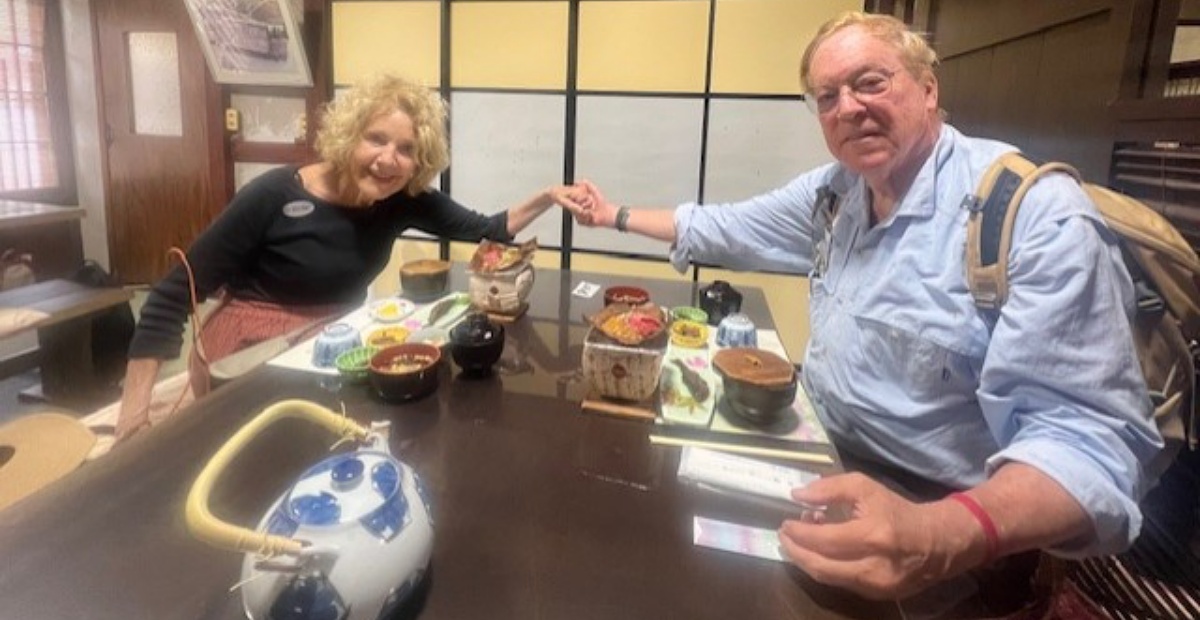
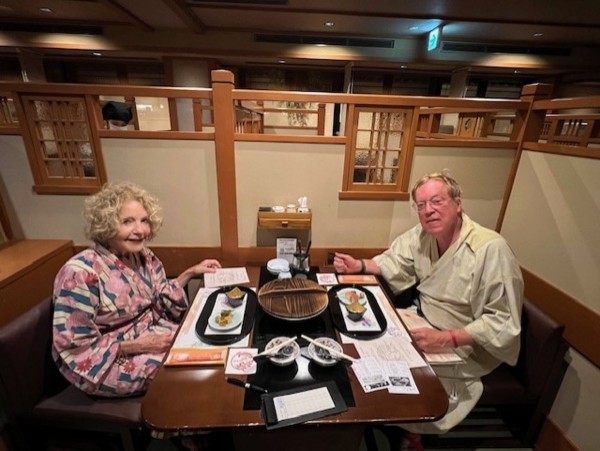 Meal at Kyoto ryokan
Jonye: The fourth thing I noticed about Japan is that I absolutely love the life-style of a Ryokan.
When I come home at night, I take a shower and eat dinner in my pajamas. When I enter a Ryokan I take a shower, soak in hot water, and eat dinner in pajamas (or a kimono). At home I eat breakfast in my pajamas, and in a Ryokan, everyone goes to the dining room for breakfast wearing a kimono or pajamas. I often lounge around my house in pajamas, and inside a Ryokan everyone wears either a kimono or pajamas and nothing underneath.
Ryokans are traditional Japanese Inns, and they provide slippers, pajamas, and kimonos. Shoes are not allowed, and street clothes are not worn. Many Ryokans have shared bathrooms, and we were asked to leave our slippers at the door and change into separate slippers provided in the bathroom.
Our rooms typically had shoji screen walls, and Tatami mats on the floor. Slippers are not allowed on Tatami Mats and are left outside in a small entrance. During the day a low table with cushions sits in the center of the room, and dinner was served on the table. After dinner the table was moved and replaced by futons and comforters. One shoji screen wall typically opened onto a second, narrower room that, in turn, opened out to a private garden
Every Ryokan has at least one pool of hot water for men to soak and one for women, and many have both indoor and outdoor soak pools I was sitting naked in an outdoor pool sharing smiles with two Japanese women about my age when suddenly they began singing to me. . A young woman sitting with us explained they were singing about the pool and how happy they were to be in the water.
The fifth thing I noticed about Japan is how much I missed my morning coffee.
Ted missed his Life cereal, and we never got used to the ever present whole, small fried fish staring up at us from the traditional Japanese breakfast table. Japanese hotels provide pajamas, and the last couple of mornings of our trip, we greatly enjoyed wearing pajamas, ordering room service, and eating cereal, scrambled eggs and lots of coffee in our untraditional, Highrise hotel room.
Conclusion
Why do this? Because we can still do it, and wanted to do it And may do more later on.
